
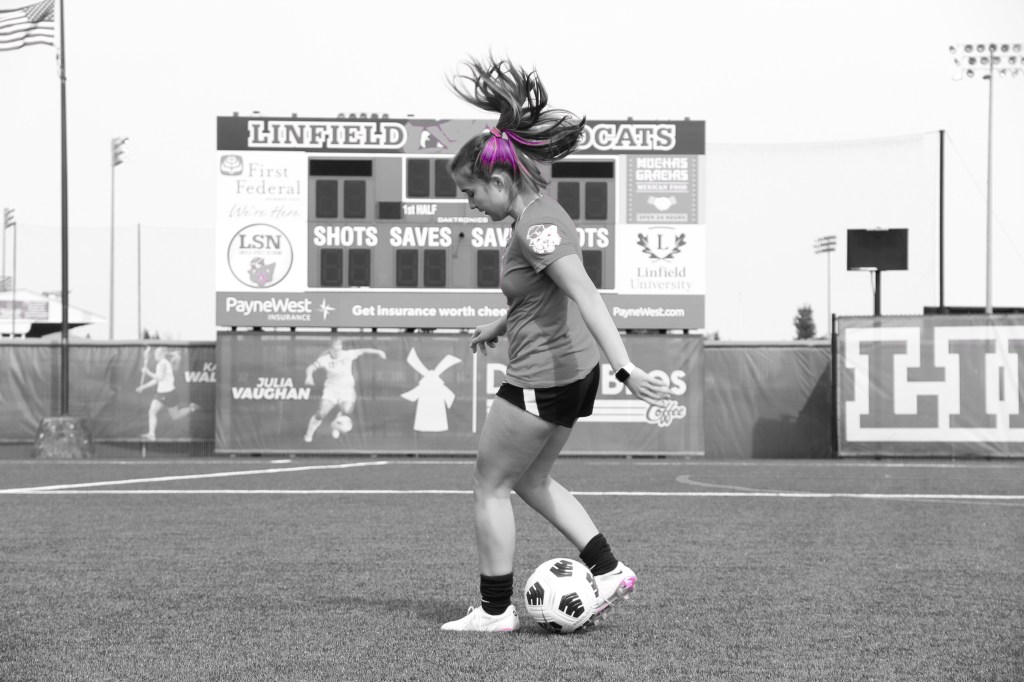
The Equality of Sports Through Social Media
By Kate Walkup
Many female athletes are told from a very young age that they should quit playing sports and instead play with dolls or focus on their social life and friendships. However, if a boy were to express interest in theater instead of football, some parents and coaches would nearly have a heart attack. Many of these ideas come from the media, and even at the collegiate level, these thoughts are still being planted in the heads of athletes and spectators. The University of Oregon’s sports Instagram page @goducks went nearly six months in 2019 without even mentioning a female athlete. After realizing their mistake, the sports communications office mended the damage by integrating images of female athletes along with their post about football and men’s basketball. After never featuring a female athlete on the page for nearly half a year, were the steps the communications professionals took substantial enough to equalize the gender inequality they presented in sports media? The Oregon Ducks Instagram page did recover to some extent from their drought in featuring women’s sports, but they still have a long road ahead of them in the efforts of equalizing men’s and women’s athletics along with the rest of the world.
Female athletes have been underrepresented throughout the entirety of the media. Ever since Title IX (Rothman, 2017), the battle to force equality in the sports world has continued. Once women’s athletics were able to have federal funding in 1972, the female athletes still had to undergo certain tests to make sure they were not men pretending to be women (Scheadler & Wagstaff, 2018). The media also approaches the way they promote male and female athletes in a different way. For instance, television networks choose to use different camera angles and shots when highlighting female sports. According to the article Exposure to Women’s Sports: Changing Attitudes Toward Female Athletes in The Sport Journal, writers Scheadler and Wagstaff addressed the issues of sexualizing female athletes in the media and sports coverage. “The emphasis on their bodies and sexuality could be putting women and girls at risk for anxiety and fear” (Scheadler & Wagstaff, 2018). This practice of featuring female athletes as bodies instead of athletes in the media could lead to serious problems involving body image issues and depression.
While the media has begun to equalize the coverage of men’s and women’s sports, they still have a long way to go. March Madness for women’s college basketball was going to air on national television for the first time in 2020 (try to find article that says this) before the tournament was canceled due to the COVID-19 pandemic. On various college sports social media accounts, male athletes are blatantly featured way more often than female athletes. An Instagram or Twitter account can go weeks, even months without featuring a female athlete. Sports media outlets also present sports as either feminine or masculine. The announcers introduce them differently at the start of a game or race (Scheadler & Wagstaff, 2018), and when women are featured on social media, the captions do not promote their athletic ability as much as they do for men. The Sports Journal addressedthe issue of treating male and female athletes differently through the media.
The media, for example, present sports as if there are masculine (e.g., football and ice hockey) and feminine (e.g., gymnastics and figure skating) sports, aligning with traditional expectations of male and female athletes (36, 44), which makes it more difficult to break traditional gender barriers and allowing women to participate in masculine sports and men to participate in feminine sports (Scheadler & Wagstaff, 2018).
All athletes should be treated equally, especially when they are competing in the same sport. For example, in track, all the distance runners should be featured equally regardless of their gender. The top collegiate female long-distance runner should be featured on the college’s athletic page just as frequently as their quickest male long-distance runner. Although social media pages and television networks are starting to acknowledge the accomplishments of women in sports, female athletes are still far more underrepresented than male athletes.
One college athletics page failed to feature female athletes for nearly six months. This was the University of Oregon’s athletic Instagram account. From April 6th to September 26th of 2019, their feed exclusively featured male athletes. On April 6th, they posted a picture of basketball phenomenon Sabrina Ionescu after she announced she would be returning to the University of Oregon for her senior season (Ionescu, 2019) instead of declaring for the 2019 WNBA draft where she had the chance of becoming the number one pick. On September 26th, they posted a picture of volleyball player Willow Johnson in preparation for the season. Between this time, @goducks exclusively shared pictures of male athletes, primarily football players. In an interview in September of 2019 with Robert Moseley, editor-in-chief for all Oregon athletics, he shared his disappointment in the University’s failure to highlight female athletes over the summer. Moseley shared how he regrets not breaking the streak of posts featuring male athletes. While football and men’s basketball do bring in substantial revenue, they are not the only programs with a fan following. A few years ago, Senior Associate Athletic Director and Senior Women’s Administrator for the University of Oregon Lisa Peterson talked about the importance of football and men’s basketball because of how much revenue they bring in.
In this interview conducted by student-athlete Savanna Peters, Peterson talked about the importance of balancing and prioritizing media content that the university’s sports communications office practices ever day.
The way that Rob operates is that he wants every sport to have what they need to be successful. Does it mean that all the numbers look exactly the same? No it doesn’t… You can’t look across the board and say okay everything is exactly the same because that’s not what it is (Peters).
Peterson went on to share her thoughts on women’s sports and whether or not they would bring in enough money without men’s sports. At the time, she did not think that this was possible. However, this interview was conducted several years ago. Before Ionescu’s class came to the University, the women’s basketball games were only bringing in around 2,000 fans each game. By Ionescu’s senior season, the ducks were averaging almost 11,000 fans per game. These were much higher numbers than the men’s program was receiving. However, even with nearly every game sold out and a rapidly growing fan base, the women’s basketball team still only brings in a fraction of the University’s athletic revenue. “People aren’t going to pay that type of money to come watch women’s sports. Only because I don’t think there is enough interest,” said Peterson. The University has seen an opportunity to highlight women’s sports through social media. Since sports do not receive equal coverage through television, social media can be a platform that can equalize this gap. However, the @goducks Instagram still fell short of this goal during summer of 2019.
After Moseley shared his regrets about the @goducks Instagram page, many more female athletes began to be featured. The volleyball team saw much more coverage during their 2019 season, and by early October, Ionescu and fellow senior teammate Ruthy Hebard made their first appearance on the page for women’s basketball since the beginning of April. While more football posts showed up in the @goducks Instagram feed, volleyball, women’s basketball, and men’s basketball ever so slightly evened the playing field. Aside from Oregon posting more about female athletes, they have also improved their ability to feature the athletes as strong competitors just like the male athletes. In one of the Oregon Ducks’ IGTV series called Unfinished Business, the women’s basketball players shared some of the shoes Nike gave them for their season. Former player Morgan Yaeger shared a bigger meaning behind the gifts from Nike.
I don’t think it’s just a male thing to like shoes and sneakers and Jordans. We can relate to that too. It’s cool for us as women to be able to show what we like so we can inspire younger generations (Oregon Ducks, 2020).
It is important for the younger generations of athletes to have people to look up to like Yaeger in their lives, but in order for this to happen, these female athletes need to be highlighted through platforms like social media. @goducks has substantially improved their page to better include female athletes, but they have not fully erased gender inequality.
While the Oregon athletics Instagram page has taken many steps in the right direction of equalizing male and female athletics, they are still falling short of completely evening out the playing field. A scholarly article written several years ago about the unfairness and inequality of sports through the media relates to some of the hurdles the university’s sports social media is trying to clear. The article The Impact of the Media on Gender Inequality Within Sport written by Eoin Trolan talked about the attitude that the media forces on sports (Trolan, 2013). Early on, young boys are encouraged to join as many sports teams as they can and watch sporting events on TV, but girls are escorted away from sports. Trolan explained how men are seen as fierce competitors while women are seen as having emotions that come first and athletic abilities that proceed those emotions.
In reinforcing masculinity, the media highlights the physical appearance of an athlete, the pose of an athlete, with the written text which accompanies a photograph. Sport media not only avoids covering women athletes, but when it does cover them, those athletes conform to the Eurocentric ideals of what a woman must be as both an athlete and a woman (Trolan, 2013).
Sharing the personality of an athlete through social media can be an important publicity or recruiting tool, but it should not be a way of differentiating women from men. If a university is going to do a feature on a female athlete and share a bit about her personality, they should produce a similar feature on a male athlete. Likewise, if a university decides to post an action shot of a male high jumper clearing the bar, then they should follow by posting an image of a female pole-vaulter clearing the bar as well. While not all content has to be identical, the majority of publicity shown on social media should have a universal attitude between male and female competitors.
Although sports media accounts like @goducks have taken multiple steps in the direction of equalizing men’s and women’s sports, many more steps still lie ahead. Promotional videos like the Unfinished Business series help share with media consumers that it is normal for female athletes to enjoy the same things that male athletes get excited about. Sharing that men have emotions and lives outside of sports can also help even out the imbalanced stereotype of male athletes only being tough and strong and never breaking down. Hopefully the more representation female athletes have in the media, the more opportunities will open up for them in the sports industry. @goducks did step up and highlight more of the talent from their female athletes, but the question of whether or not this will continue still stands. Ionescu made it easy for them to post about her due to all of her accolades and achievements. Breaking a habit can seem like the most difficult task in the moment, but keeping that habit broken stands on a completely different level.
In JAMS 230: Media Theory & Criticism, I wrote my final research paper about the issues of equality through sports. From understanding media theory, I was able to take issues that arise in the media pertaining to sports and criticize how they affect various athletes and athletic groups.
 Kate Walkup